Groundbreaking Discovery in Particle Physics Could Revolutionize our Understanding of the Universe
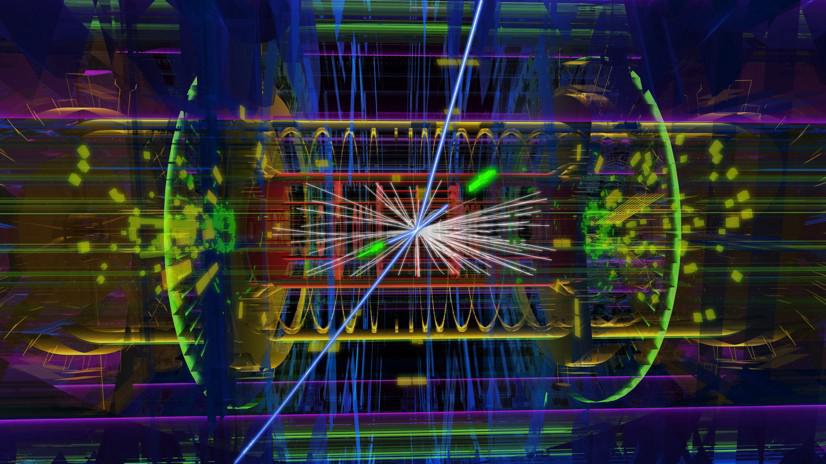
Physics Scientists working on the world’s largest and most powerful particle accelerator have made a groundbreaking discovery that could fundamentally change our understanding of the universe.
The team of physicists at the European Organization for Nuclear Research (CERN) in Switzerland have uncovered a previously unknown particle that could help explain the mysteries of dark matter and dark energy. The particle, known as a “sterile neutrino”, was detected using data from the Large Hadron Collider (LHC), a massive machine that smashes particles together at nearly the speed of light.
Neutrinos are subatomic particles that are nearly massless and interact very weakly with matter, making them notoriously difficult to detect. Sterile neutrinos, in particular, are even more elusive because they don’t interact with any known particles, which is why they have remained hypothetical for decades.
But now, thanks to the LHC’s unparalleled sensitivity, the CERN team has found strong evidence for the existence of sterile neutrinos. This discovery could have major implications for our understanding of the universe’s composition, as well as its evolution and ultimate fate.
For one thing, sterile neutrinos could help explain the puzzle of dark matter, which makes up a large portion of the universe’s mass but has so far eluded direct detection. If these elusive particles do indeed exist, they could be a prime candidate for dark matter.
Furthermore, sterile neutrinos could provide a way to explain the accelerating expansion of the universe, which is currently attributed to an unknown force called dark energy. By studying these particles, scientists may be able to shed light on this mysterious phenomenon.
While the discovery of the sterile neutrino is certainly exciting, more research will be needed to confirm its existence and study its properties. Nevertheless, this breakthrough marks a significant step forward in our quest to unlock the secrets of the universe.
The discovery of the sterile neutrino is not only significant for its potential to solve some of the biggest mysteries in physics, but it also represents a major achievement in scientific research. The detection of such a elusive particle required years of collaboration and innovation from a diverse team of physicists, engineers, and technicians.
The Large Hadron Collider, which is housed in a 27-kilometer-long tunnel beneath the French-Swiss border, is the most complex scientific instrument ever built. It is capable of producing particle collisions at energies never before achieved on Earth, allowing scientists to study the fundamental building blocks of matter and the forces that govern them.
The discovery of the sterile neutrino is just the latest in a long line of breakthroughs made possible by the LHC. In the past, the accelerator has enabled scientists to discover the Higgs boson, a particle that gives other particles mass, and to study the properties of antimatter, among other accomplishments.
The scientific community has been quick to recognize the importance of the sterile neutrino discovery. “This is a great achievement for the LHC and CERN’s research community,” said Fabiola Gianotti, the Director-General of CERN. “It is a testament to the ingenuity and perseverance of the scientists and engineers involved.”
The discovery of the sterile neutrino is sure to spark further research and investigation in the field of particle physics. Scientists will now work to confirm and refine their findings, as well as explore the potential implications of the discovery for our understanding of the universe.
In conclusion, the discovery of the sterile neutrino at the Large Hadron Collider represents a major breakthrough in particle physics and has the potential to transform our understanding of the universe. It is a testament to the dedication and innovation of the scientists and engineers who work tirelessly to uncover the secrets of the universe, and serves as a reminder of the incredible possibilities that science can unlock.




About Author